How to Choose a Mini Excavator for Your Job
When selecting a mini excavator, it may seem like all you need to do is determine the appropriate tonnage, but in reality, there are many details to consider during the purchasing process. If the machine is too small, it may not meet requirements for digging depth, operational efficiency, and attachment use; if it’s too large, it may be constrained by construction space, transportation conditions, and the procurement budget.
If you’re learning how to choose a mini excavator, start by assessing your actual job requirements, then gradually compare the machine’s overall dimensions, operating weight, digging capacity, hydraulic system, and specifications. Below, we’ll break down these factors one by one to help you narrow down your options.
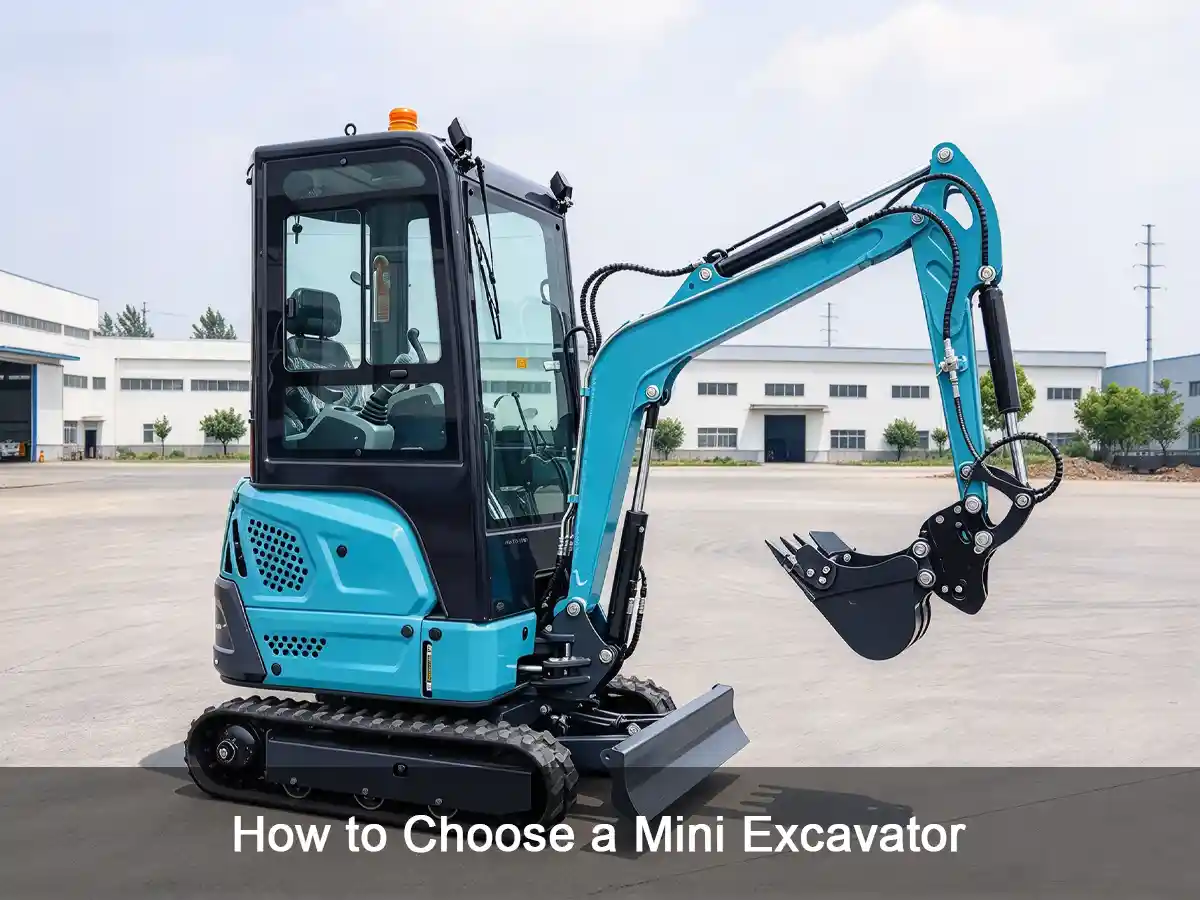
Table of Contents
Define Your Job Requirements Before Choosing a Mini Excavator
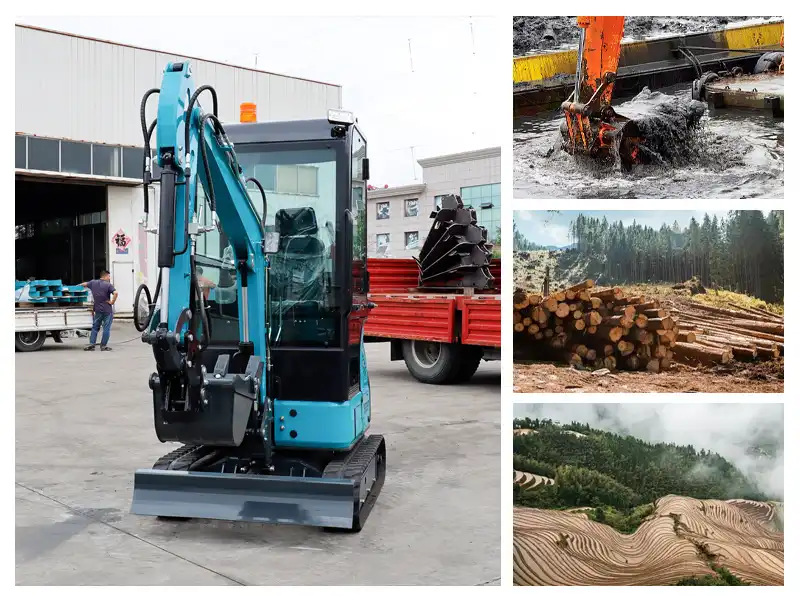
Before purchasing equipment, clearly define the tasks you plan to perform. Trenching, landscaping, pipe laying, and foundation excavation all place different demands on the machinery. Even for equipment of the same tonnage, different attachments and hydraulic configurations can affect actual performance.
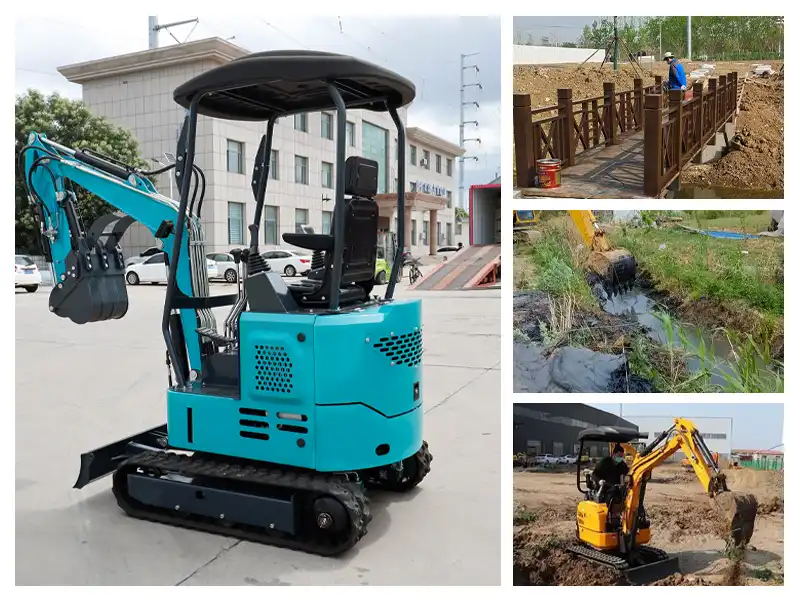
What Types of Work Will the Excavator Handle?
- Trenching: Excavation of drainage ditches, cable trenches, and pipeline trenches.
- Landscaping: Site preparation, earthmoving, and landscaping work.
- Foundation Work: Excavation of small foundations and construction around buildings.
- Utility Installation: Assistance with the installation of water pipes, sewer lines, and other underground utilities.
- Farm Work: Farm drainage, land preparation, and routine maintenance.
- Light Demolition: Performing selective demolition using appropriate demolition attachments.
Different tasks have varying requirements for digging depth, operating radius, bucket size, and hydraulic systems. For example, teams that regularly perform pipeline trenching should focus on digging depth, trench width, and work efficiency; teams that frequently work in residential backyards should prioritize the machine’s overall width and swing radius.
| Working Scenarios | Recommended Weight | Description |
|---|---|---|
| Greenhouses, dense orchards, indoor renovation | 0.6–1.5 ton | Narrow body, can pass standard doorways, flexible rotation in tight spaces |
| Ditching in open orchards, yard renovation | 1.5–2 ton | Balances digging depth and mobility; the mainstream option for home use |
| Municipal piping, small earthwork, farmland reclamation | 2–3.5 ton | Higher working efficiency; transportation by trailer required |
How Much Digging Depth and Reach Do You Need?
Actual construction also involves factors such as the working radius, the distance between the excavator and the trench, the dump height, and whether the machine needs to be moved frequently. If the trench is deep, or if the soil needs to be loaded onto high-sided transport vehicles on-site, you should verify the maximum digging depth, maximum digging reach, and dump height simultaneously.
It is recommended to determine the required parameters based on the most common construction tasks and allow for a reasonable margin of error. Do not wait until the equipment arrives on-site to discover that the excavator boom cannot meet the on-site requirements.
Among small excavators, the 1-metric-ton class typically has a digging depth of about 2 meters, while the 6-metric-ton class can reach up to 3.8 meters. Let’s look at specific scenarios:
- Yard renovations and orchard fertilization trenches: In practice, the actual depth of orchard fertilization trenches is usually between 40 and 50 centimeters. A model with a digging depth of 2 meters or more is sufficient, primarily to allow for future needs.
- Orchard cable burial and ditches: Generally, these do not exceed 1.5 meters, so a model capable of reaching 1.5 meters is sufficient.
- Pipe trenches, cable trenches, and irrigation channels: A digging depth of around 2.2 meters generally covers common needs.
- Small-scale earthwork and foundation excavation: A digging depth of 2.5 meters or more is recommended for greater versatility.
Note: The rated digging depth is a test value measured on ideal, level ground using a standard bucket. Digging in clay is 10%–15% shallower than in sandy soil; on soft ground, the machine’s body may sink, further reducing the actual depth by 10%–15%*; and hard rock layers may be impossible to excavate at all.
How Much Space Is Available on the Job Site?
The number of hours a machine is used each day and the number of days it operates per week will influence the choice of equipment configuration. If the machine is primarily used for sporadic, small-scale projects, factors such as ease of operation, simple maintenance, and flexible transport may be more important. Conversely, if the equipment is intended for long-term, continuous construction work, greater emphasis should be placed on the hydraulic system, engine performance, maintenance intervals, the availability of wear parts, and after-sales support.
Equipment selection should be based on the primary tasks the machine will perform; one should avoid opting for an overly high-end configuration just to accommodate a few rare or specialized operating conditions.
How to Choose the Right Mini Excavator Size
The size of a mini excavator is one of the factors most likely to lead to misjudgment during the procurement process. Buyers often begin by comparing different tonnage classes—such as 1-ton, 2-ton, 3-ton, or 5-ton models—but tonnage serves only as an initial screening criterion and does not fully represent a machine’s overall operational capabilities.
What Size Mini Excavator Do You Need?
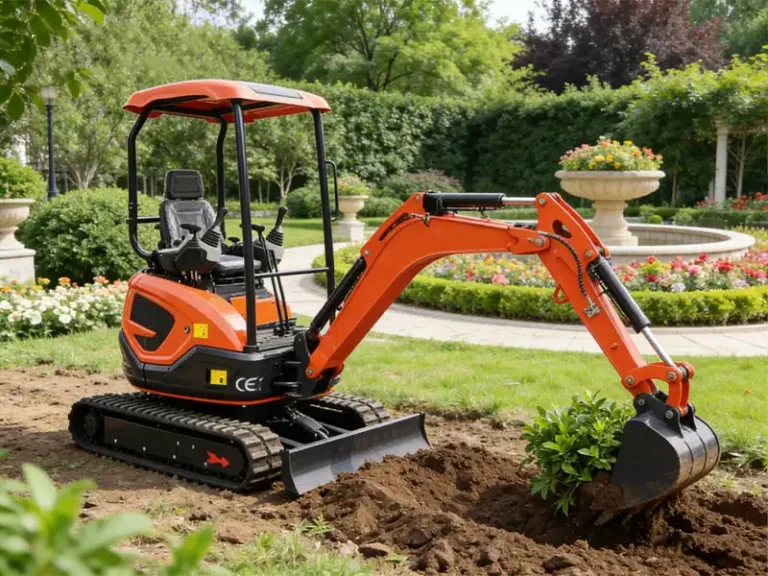
For residential use, prioritize 1-2t mini excavators. Among these, the 1.5t model is the ideal choice for orchards and greenhouses, while the 1t model offers greater flexibility for small yard jobs.
- Small-scale and confined-space operations: Prioritize overall machine width, entry clearance, transport weight, and on-site turning radius.
- Standard trenching and landscaping: Make your selection based on a combination of digging depth, operating radius, bucket size, and daily workload.
- Heavy workloads or frequent earthmoving operations: Focus on comparing digging capacity, hydraulic performance, stability, and sustained productivity.
- When using hydraulic attachments: In addition to the machine’s tonnage, verify auxiliary hydraulic flow, pressure, and attachment compatibility.
Micro (1–2 metric tons)
Applications: Small residential gardens, flower beds, narrow paths, irrigation ditches, and light-duty planting operations.
Key Specifications: Overall width ≤ 1.2 meters (fits through standard doorways), digging depth 1.5–2.0 meters, low ground pressure (≤ 28 kPa).
Advantages: Minimal damage to lawns; zero-tail swing design for maneuvering in tight corners; easy transport between job sites using a lightweight trailer.
Compact (2–3.5 metric tons)
Applications: The vast majority of professional landscaping tasks—tree planting, site grading, small retaining walls, driveway preparation, and light demolition.
Key Specifications: Digging depth 2.0–2.8 meters, digging force 11–16 kN, overall width 0.9–1.2 meters.
Advantages: Balances power and maneuverability; can be equipped with attachments such as augers, thumb grapples, and grading blades.
Medium-sized (3.5–6 metric tons)
Applications: Large-scale landscaping, terraced land grading, extensive soil excavation, pond construction, and commercial hardscape projects.
Key Specifications: It offers greater digging depth (2.8–3.3 meters), higher lifting capacity, and excellent stability when operating with heavy-duty attachments.
Advantages: It can sustain heavy-duty operations while remaining adaptable to most construction sites.


Mini Excavator Size Comparison by Operating Weight
| Comparison Item | Why It Matters | Application Scenarios / Judgement Basis |
|---|---|---|
| Operating Weight | Affects transportation, ground bearing capacity and working stability | Check against trailer load capacity and site conditions |
| Overall Width | Determines whether the machine can pass narrow entrances | Measure the actual passage width |
| Maximum Digging Depth | Determines if excavation to the required depth can be achieved | Match requirements of trenches, pipelines and foundations |
| Maximum Working Reach | Affects working position and movement frequency | Match excavation area and machine parking position |
| Dump Height | Affects loading and dumping operations | Match transport vehicles or dumping positions |
| Bucket Capacity | Affects single loading volume and work rhythm | Select according to soil type, bucket and machine capacity |
| Hydraulic Flow and Pressure | Determines normal operation of hydraulic attachments | Meets the technical requirements from attachment manufacturers |
| Transport Dimensions | Affects loading, unloading and transport arrangement | Verify dimensions and weight of the machine, attachments and transport equipment |
Be sure to distinguish between operating weight, shipping weight, and the machine’s rated working capacity. Different manufacturers may specify the total machine weight based on different configuration conditions; when comparing specifications, verify whether the weight includes the cab, working attachments, buckets, and other accessories.
Is a 1-Ton, 2-Ton, 3-Ton, or 5-Ton Mini Excavator Right for You?
| Machine Weight Class | Main Considerations | Key Points to Verify Before Purchase |
|---|---|---|
| 1-ton class | Light-duty construction, confined spaces and small-scale landscaping | Entry width, digging depth, overall machine stability |
| 2-ton class | Small trenching, landscaping and general maintenance tasks | Working radius, bucket configuration, transport conditions |
| 3-ton class | Versatile small construction and pipeline-related works | Digging performance, hydraulic setup, site accessibility |
| 5-ton class | Heavy workload projects requiring higher operating capacity | Lifting capacity, transport weight, site space and continuous working performance |
These classifications are intended solely to help buyers narrow down their selection criteria and do not imply that a specific tonnage is necessarily suitable for a particular construction task. Even among machines of the same tonnage, there may be significant differences in digging depth, machine width, and rated lifting capacity between different models.
If the equipment is to be used for resale, rental, or bulk purchasing, the distribution of operating conditions among key customers should also be considered. A versatile model suitable for most projects typically maximizes equipment utilization more effectively than a configuration suited only for a few specialized scenarios.
Why Bigger Is Not Always Better
A larger machine does not necessarily mean higher project returns. As equipment tonnage increases, transportation requirements, on-site access conditions, procurement costs, and routine maintenance expenses may all change accordingly. If the primary task involves digging trenches around residential properties, equipment that is too large may have difficulty accessing the site; if deep trench excavation is frequently required, a machine that is too small may need to be moved more often or may fail to meet construction requirements.
The best approach is to first determine the minimum operational requirements, then compare several models that meet those requirements, and select the one with the most favorable total cost of ownership.
Compare the Key Mini Excavator Specifications
Operating Weight affects equipment transportation, ground load capacity, and stability under certain operating conditions. Before purchasing, confirm which configuration the manufacturer’s stated weight refers to, to avoid directly comparing the weight of a bare machine with that of another machine that includes work tools and attachments.
Operating Weight and Machine Dimensions
Operating Weight affects equipment transportation, ground load-bearing capacity, and stability under certain operating conditions. Before purchasing, confirm which configuration the manufacturer’s stated weight refers to, to avoid directly comparing the weight of a bare machine with that of another machine that includes work tools and attachments. Overall Width, Overall Height, and Overall Length determine whether the equipment can pass through construction site entrances and whether it is convenient to load onto a truck for transport.
For users who need to operate in narrow passages, it is recommended to record the minimum clearance dimensions at the job site and then cross-check them against the dimension charts for specific models. Do not rely solely on product images to determine whether the machine is compact enough.
Maximum Digging Depth and Working Reach
The digging depth determines whether the equipment can complete the target trench or foundation excavation, while the working radius determines the area the machine can cover. If the equipment is primarily used for drainage pipe construction, you should verify the trench depth, trench location, the reach of the working attachment, and the soil disposal location. Comparing only the maximum digging depth may overlook the horizontal distance, which is equally important in actual construction.
It is also important to note that the maximum values published by manufacturers are typically obtained under specified test conditions. Actual performance may be affected by factors such as ground conditions, work tool configuration, and operating methods.
Engine Power and Hydraulic Performance
Engine power is an important factor in selecting equipment, but it does not solely determine construction efficiency. For equipment that requires attachments such as hydraulic breakers, augers, or grapples, auxiliary hydraulic flow and hydraulic pressure are equally critical. The flow rate and pressure must match the attachment’s requirements; otherwise, even if the attachment can be installed, it may not perform as intended.
When purchasing, it is recommended to request the hydraulic specifications for the specific model from the supplier and specify the types of attachments you plan to use. For users who need to frequently switch between different attachments, you should also confirm that the auxiliary hydraulic circuit, hose connections, and control methods meet your actual operational requirements.
Bucket Capacity and Digging Force
Bucket size must be matched to the machine’s capacity and soil conditions. Larger buckets can increase the load per scoop, but actual operation may be limited if the soil is hard, digging resistance is high, or the equipment itself is not suitable for that bucket. Conversely, a bucket that is too small may increase the number of passes required.
If the primary task is trench excavation, compare a standard bucket with a narrow-trench bucket; if loading, grading, or material handling are also required, the bucket type should be determined based on the specific application.
Lifting Capacity, Dump Height, and Stability
If the equipment is to be used to transport pipes, auxiliary installation materials, or perform lifting operations, you must verify the rated lifting capacity and load chart for the specific model. Lifting capacity is affected by factors such as working radius, lifting height, machine configuration, and direction of operation. You cannot determine the maximum weight the machine can lift based solely on the machine’s total tonnage.
Additionally, verify that the unloading height meets on-site loading requirements and that the equipment complies with the manufacturer’s safety operating guidelines under planned operating conditions.
Choose Between Zero Tail Swing and Conventional Tail Swing
The key decision-making factor when selecting a mini excavator is this: choose a zero-tail swing model for narrow urban work sites, and a conventional tail swing model for open areas. The fundamental difference between the two lies not in digging force, but in the tail swing radius—when a zero-tail swing model swings, its tail does not extend beyond the width of the tracks, whereas the tail of a conventional tail swing model extends outward by 30–50 cm. This difference directly determines whether the machine can enter the site and whether it can turn around.
Zero Tail Swing vs. Conventional Tail Swing
Zero Tail Swing: Through optimization of the swing center, integrated counterweights, and a compact component layout, the entire upper structure is contained within the track width, enabling 360° on-the-spot rotation without hitting any obstacles.
Conventional Tail Swing (Short Tail): The tail counterweight extends outward as usual. This design features a simple structure and low manufacturing costs, but carries a risk of collision during rotation. Strictly speaking, “short tail” refers only to a smaller tail extension—it is not truly zero tail swing—and still requires multiple forward and backward adjustments in extremely narrow spaces.
| Working Condition | Recommended Model | Core Reason |
|---|---|---|
| Urban pipe network, old town renovation, indoor demolition | Zero-tail swing | Extremely limited space. Zero tail swing enables smooth access and efficient operation |
| Orchard planting, garden maintenance, greenhouse work | Zero-tail swing | Suitable for both narrow passages and low-height working environments |
| Equipment rental (multi-scenario jobs) | Zero-tail swing | Wide application range, higher utilization & rental rate, faster ROI |
| Open farmland, water conservancy projects, large earthworks | Conventional Tail Swing | Great cost performance, simple structure and low maintenance cost |
Real-world test data illustrates the difference: When making a 90-degree turn in a simulated 1.5-meter-wide passageway, a zero-tail model can complete the maneuver in a single pass, while some short-tail competitors require multiple forward and backward adjustments. In scenarios such as older residential complexes and interior renovation projects, the zero-tail design can boost construction efficiency by more than 40 percent.
When selecting a machine, we recommend reviewing the overall dimensions diagram or watching on-site demonstration videos. If the workspace is extremely limited, you should further verify the machine’s actual footprint at different turning angles.
Select the Right Track Type for Your Terrain
The type of tracks affects the equipment’s adaptability to the ground, wear and tear, and maintenance costs. The decision between rubber tracks and steel tracks should be based on the construction site conditions and the frequency of equipment use.
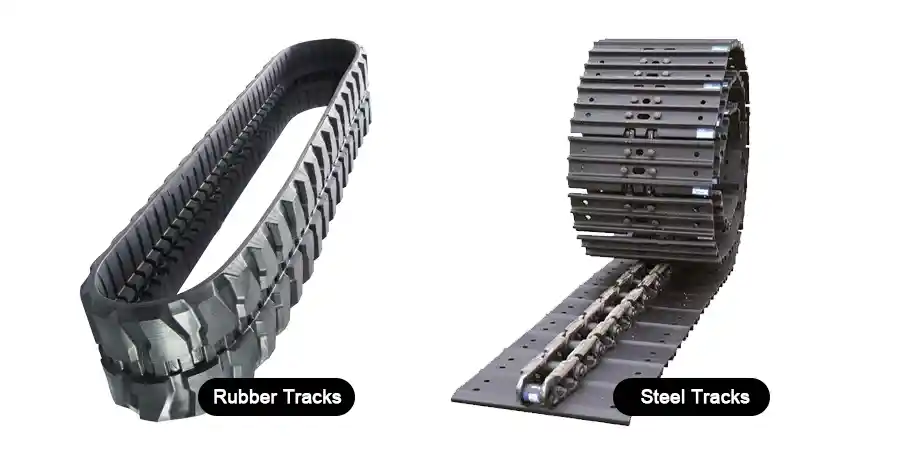
Rubber Tracks vs. Steel Tracks
Rubber Tracks: Typically suitable for work environments where ground damage needs to be minimized, such as around residential areas, for lawn maintenance, and in some partially paved areas. However, the actual ground protection effectiveness is also affected by the condition of the tracks, the ground material, and operating methods.
Steel Tracks: These can be used in construction environments with varying requirements for wear resistance and ground adaptability; however, their weight, method of ground contact, and impact on the finished surface must be considered in light of specific operating conditions.
Which Tracks Work Best on Soft Soil, Gravel, and Finished Surfaces?
- Soft Soil: Pay attention to ground pressure, ground bearing capacity, and track configuration.
- Gravel: Consider track wear caused by gravel, as well as daily inspection and maintenance requirements.
- Finished Surfaces: Pay attention to surface protection, steering maneuvers, and track cleaning.
- Uneven Terrain: Verify the machine’s stability, undercarriage design, and the manufacturer’s specified operating limits.
If a piece of equipment needs to be used on multiple types of surfaces, it is recommended to base the selection on the primary operating environment and then assess whether additional configurations or operational measures are needed for other scenarios.
Choose Attachments That Match Your Work
Standard Buckets and Trenching Buckets
Standard buckets are suitable for a variety of common excavation tasks, while trenching buckets are typically used for construction projects that require precise control over trench width. If the equipment is primarily used for pipe laying, you should first determine the pipe’s outer diameter, trench width, excavation depth, and soil type before selecting the appropriate bucket. For teams that need to handle a variety of tasks, different buckets can be configured based on actual usage frequency.
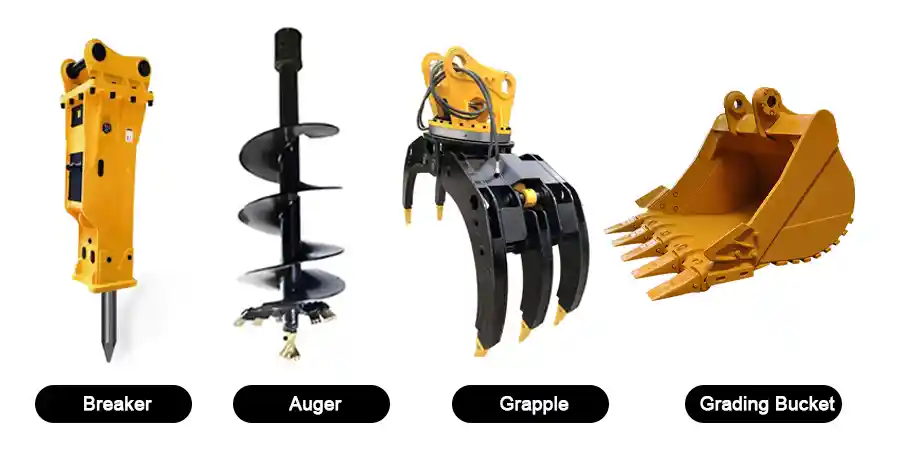
Hydraulic Breakers, Augers, and Grapples
Hydraulic Breaker: Used for breaking operations that meet the equipment’s capacity requirements.
Auger: Used for drilling and certain foundation work.
Grapple: Used for material handling and transport in accordance with the attachment’s design specifications.
Grading Bucket: Used for site preparation and grading tasks.
Different attachments vary in weight, connection methods, and hydraulic requirements. Before purchasing, you should confirm whether the machine supports the corresponding attachment, rather than judging compatibility based solely on the shape of the interface or the tonnage rating.
Diesel vs. Electric Mini Excavators
The choice between a diesel mini excavator and an electric mini excavator should be based on a combination of factors, including the work environment, daily operating hours, charging conditions, and long-term costs.
When a Diesel Mini Excavator Makes More Sense
Diesel-powered models can be considered as viable options for many routine outdoor construction projects, particularly those requiring extended periods of continuous operation and where on-site refueling options are limited.
When making a purchase, attention should be paid to engine power, fuel consumption, maintenance requirements, emissions standards, and local after-sales support. Operating costs vary significantly among different models, so it is not advisable to determine which model is more economical based solely on the type of power source.
When an Electric Mini Excavator Is Worth Considering
Electric models are worth considering for indoor construction projects, situations with strict noise restrictions, or scenarios where on-site exhaust emissions need to be reduced.
However, before purchasing, it is important to verify the battery capacity, actual operating time, charging time, charging infrastructure, and local operating conditions. If a project requires prolonged continuous operation, recharging arrangements must also be factored into the equipment selection plan.
| Dimension | Diesel Version | Electric Version |
|---|---|---|
| Price | Base price | 30%~50% more expensive than diesel model |
| Continuous Operation Duration | Refuel and go, unlimited runtime | 4~6 hours for standard 3-ton model, around 6.5 hours for large-battery version; charging takes several hours |
| Noise | 85~95 dB inside the cabin | Operating noise below 75 dB |
| Energy Cost | Fuel consumption: approx. 15~30 L/hour | Energy cost reduced by 40%~60% |
| Power Response | Throttle control, delayed power output | Motor delivers peak torque in 0.1s for more responsive movement |
| Energy Efficiency | Thermal efficiency: 35%~45% | Conversion efficiency: 75%~95% |
Choose a diesel model for long hours of outdoor work, and an electric model for indoor use if you’re concerned about environmental impact. If your budget allows and you have access to charging facilities, the electric version is more cost-effective in the long run.
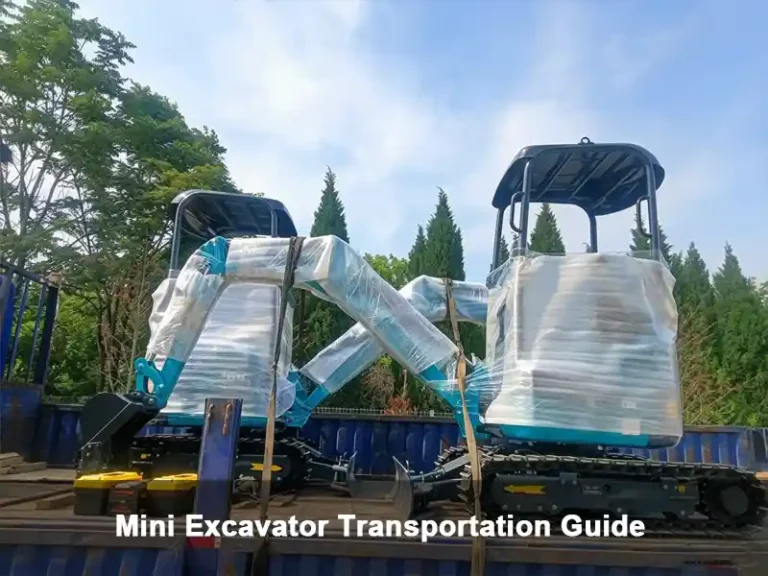
Check Transport Requirements Before Buying
Whether equipment can be transported smoothly is an issue that is often overlooked during the purchasing process. Especially for users who need to conduct construction across regions, arrange for rentals, or import equipment, transport requirements should be verified before finalizing the model.
Can Your Truck and Trailer Handle the Excavator?
When verifying the rated load capacity of the trailer and towing vehicle, do not focus solely on the excavator’s weight. You must also account for the bucket, other attachments, the equipment’s own weight during transport, and relevant load restrictions. The total loaded weight must comply with the rated capacity of the vehicle and trailer and meet applicable road transport regulations. For export purchases, confirm the equipment’s shipping method and related restrictions with the freight carrier in advance.
Measure Machine Width, Height, and Loading Clearance
The machine’s overall width, transport height, and loading clearance will affect the transport route and on-site delivery. If the machine needs to pass through narrow entrances, verify its dimensions in its actual transport configuration; if the equipment needs to be loaded into a container or pass through specific transport routes, review the shipping plan in advance rather than waiting until production is complete to arrange transportation.
Check Local Transport and Emissions Regulations
Different countries and regions may have varying requirements regarding road transport, emissions, and equipment use. For export purchases, confirm the applicable regulations, equipment certifications, and import documentation requirements of the target market before placing an order. When specific emission levels or certification standards are involved, refer to the local regulatory authorities and official technical documentation.
Email: xinhao@snowyowlmachine.com
TEL/WA: +86 19939724755
How Much Does a Mini Excavator Cost?
The price of a mini excavator is influenced by factors such as tonnage, brand, engine, hydraulic system, cab configuration, attachments, purchase quantity, and delivery terms. It is difficult to determine which machine offers better value simply by comparing product quotes.
What Affects the Price of a Mini Excavator?
After receiving a quote, it is recommended that you first confirm whether the two machines are comparable. Pay close attention to the model, standard configuration, work tools, number of buckets, auxiliary hydraulic systems, shipping arrangements, warranty terms, and delivery time. A quote that appears lower may be due to differences in configuration, or it may not include additional attachments or shipping costs.
If you are a dealer or a bulk purchaser, you should also inquire about pricing terms for different purchase quantities, spare parts procurement methods, and long-term after-sales support arrangements.
New vs. Used Mini Excavators: Which Offers Better Value?
New and used equipment each have their own suitable applications. The initial purchase cost of new equipment should typically be evaluated in conjunction with its full configuration and warranty terms. Used equipment may reduce upfront costs, but before purchasing, you must inspect the actual operating hours, maintenance records, track wear, hydraulic system, engine condition, and repair history.
Do not base your decision solely on the equipment’s appearance or operating hours. The machine’s maintenance history, operating environment, and actual operating condition are equally important.
Which Optional Features Are Worth Paying For?
Whether optional features are worth purchasing depends on whether they can solve practical problems on the job. For example, teams that frequently change attachments can evaluate whether a quick coupler would improve operational convenience; those who regularly work in harsh weather conditions should consider whether a cab and related features are necessary.
For features that are used infrequently, it is not necessary to include them all at the time of the initial purchase. A more sensible approach is to prioritize features directly related to primary tasks and confirm whether future upgrades are feasible.
How to Evaluate a Mini Excavator Manufacturer or Supplier
As a manufacturer of compact excavators, Xuexiao Machinery provides technical expertise, parts support, and after-sales services—all of which are critical to the performance of your equipment once it is put into operation. If you are looking for the right compact excavator for your business, our team can assist you in evaluating equipment specifications, configurations, and your specific operational requirements. Please feel free to contact us to discuss your needs and learn more about our compact excavators.
Verify Specifications and Standard Equipment
Request that the supplier provide a technical specification sheet for the specific model, and verify the operating weight, overall dimensions, digging depth, engine, hydraulic system, and standard attachments.
If the product page displays only partial specifications, you can request a complete configuration list when making an inquiry. For different versions of the same model, you should also confirm which configuration the quote corresponds to, to avoid discrepancies between the contract, promotional materials, and the actual delivery.
Check Spare Parts Availability and Warranty Terms
Before purchasing, determine whether commonly used parts are readily available, how the warranty scope is defined, and what channels are available for technical support in the event of a malfunction.
Overseas buyers should also confirm spare parts delivery lead times, after-sales communication channels, and associated costs. For customers planning to operate a long-term equipment rental business, the stability of spare parts supply can directly impact equipment uptime.
Review Factory Inspection, Testing, and Documentation
If purchasing via export, confirm with the manufacturer the details of pre-shipment inspections, test records, packaging plans, and delivery documentation.
For bulk purchase orders, it is also advisable to agree in advance on acceptance criteria, configuration lists, delivery schedules, and procedures for handling quality issues. Clearly documenting these requirements in the purchase agreement is more practical than relying solely on verbal commitments.
FAQs

conclusion
Choosing the right mini excavator involves more than comparing prices or machine sizes. Consider the type of work you handle, available working space, digging depth, attachment requirements, transport conditions, and long-term maintenance costs. A machine that matches your daily workload can help reduce unnecessary operating expenses and make project planning easier. Before making a purchase, compare specifications carefully and confirm that the configuration suits your actual working conditions.
If you are looking for a mini excavator for construction, landscaping, agricultural work, or other compact-site applications, Xuexiao Machinery can help you explore suitable equipment options. As a mini excavator manufacturer, we can discuss your project requirements, machine specifications, and configuration needs with you. Contact our team to learn more about our mini excavators and find an option that fits your business.